

PAS 9980 has been rewritten: Three changes matter

BSI published the second edition of PAS 9980 this month. It takes effect on 30 September 2026 and supersedes PAS 9980:2022,which is withdrawn. There is no transition period, so any FRAEW commissioned from now on should follow the 2026 method.
Reports already prepared under the 2022edition are not invalidated. BSI says so expressly, and adds that the changes are not meant to significantly affect the assessment of risk. Whether an existing report should be refreshed is the dutyholder's call, taken on advice and on the circumstances of the building. Make that decision deliberately and write it down, rather than leaving it implicit.
So this is consolidation, not a reset of risk tolerance. But anyone expecting a cosmetic update will be caught out. Three changes carry real commercial consequences.
You can now prove a building does not need an appraisal
This is the most useful change for anyone holding a portfolio.
The 2022 edition told you how to carry out an FRAEW. The 2026 edition tells you first how to decide whether you need one, and gives you a decision flowchart and a short report format for recording the answer.
There are two gateways, and either one closes the question. A building is inherently low risk if it is a house, a block of no more than two storeys above ground, or a block of no more than three storeys with no obvious hazard in the external walls. Separately, no appraisal is needed where the external walls are non-combustible by construction: solid or traditional cavity masonry, walls and attachments formed entirely of A1 or A2-s1, d0 materials with adequate cavity barriers, or a close match to a system tested to BS 8414 and classified to BR 135. The PAS sets out the dimensional thresholds and the short list of excepted components such as window frames,seals and thermal breaks.
The important part is who can do it. BSI expects this triage to be within the capability of a broad range of building professionals, property managers and fire risk assessors, not only specialist fire engineers. The output is a short factual report, not a full appraisal.
For a mixed-vintage BTR or PBSA portfolio ,that converts a meaningful number of buildings from an open item carrying specialist spend into a closed item with a two-page evidence trail. It also gives boards and lenders a written answer to the question they keep asking: why is there no FRAEW for this asset?
“Tolerable”becomes an outcome in its own right
This is the change most likely to move money.
The 2022 edition used three bands: high,medium and low. Buried inside the medium band was a fork. Risk at the upper end of medium needed action; risk at the lower end was labelled “medium (tolerable)” and needed none. Outside the fire engineering community that distinction was close to invisible. Lenders, valuers, insurers and buyers saw the word medium and treated the building as failed, parenthesis or not. We have watched refinances stall and prices get chipped on exactly that misreading.
The 2026 edition splits the band and giveseach half its own name.
Risk outcomes under each edition
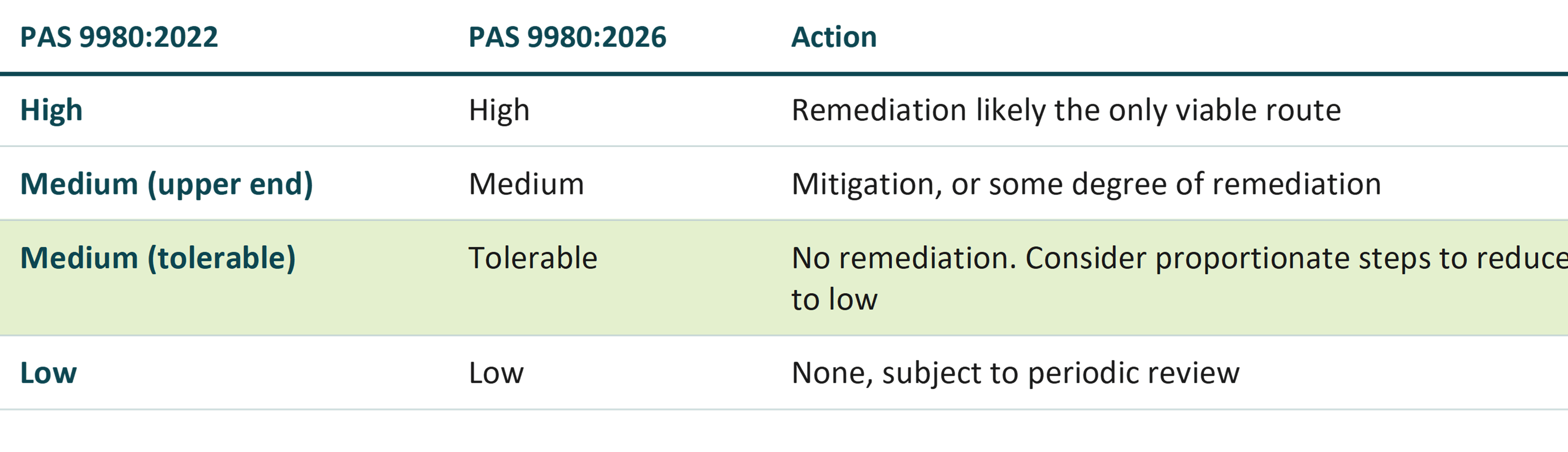
High and low are unchanged. This is a relabelling, not a loosening. But it takes the word medium off buildings that need no remediation at all. Anything keyed to the old three-band vocabulary will now produce the wrong answer: credit policy, loan documents, sale packs,internal reporting.
One related refinement matters. The 2026 edition separates the risk rating, which expresses hazard and consequence, from the risk outcome, which asks whether that risk can be tolerated and whether proportionate action exists. A medium rating with no proportionate action available therefore lands on a tolerable outcome. The PAS also states that awaking watch is not proportionate to a tolerable outcome, given its cost against its benefit: a useful line to have in print when you are negotiating with an insurer or a managing agent.
The reporting bar has moved
Consultants will feel this first. Reports must now carry a statement of competence for every signatory, with clear information on relevant experience. Two notes are pointed: qualifications applied for but not yet awarded should not be cited as evidence of competence, and a list of postnominals is not, in itself, evidence of anything.
Reports must also carry an executive summary that a resident can read, giving the outcome for each wall type and attachment as well as overall, together with constraints, limitations and sources of uncertainty. Where uncertainty is the reason an outcome is medium or high, the report has to explain why further investigation was not possible or not proportionate.
The provision with the sharpest teeth is 15.10. Where a new appraisal reaches significantly different conclusions from an earlier one, it must explain the root causes of the difference. The PAS expressly accepts that one root cause may simply be the risk appetite of the appraisers. In a market where second and third opinions are routinely commissioned to unblock a transaction, that is real discipline.
Four other things worth knowing
• The process is explicitly iterative. Start proportionate and escalate only where uncertainty is preventing a tolerable or low outcome. That legitimises staged scopes and staged fees, and strengthens the case for intrusive investigation where the spend is likely to move the outcome down a band.
• There is a framework for reviewing someone else's report. A new annex sets out five purposes for a review and grades reviewers by independence. It gives you a vocabulary for specifying what you actually want, and makes clear that a review is not a re-run of the appraisal.
• Balconies are appraised across two annexes. Construction and configuration are now separated, drawing on research commissioned by the Building Safety Regulator. Given how often balconies drive the outcome on BTR stock, flag this to your appraiser.
• Three annexes have gone. Legislative context, the B4(1) and Approved Document B material, and the history of standards are all deleted as superfluous to conducting an appraisal. The content remains correct. Keep your 2022 copy, because it is now the only place that background sits.
What to do before 30 September
Owners and funds
Re-run the triage across the portfolio before commissioning anything further. Some assets will fall out of scope entirely and can be closed with a short factual report at modest cost. For the rest, expect staged scopes rather than fixed fees. Existing reports stay valid, but the decision on whether to refresh them is now yours to take and to record.
Lenders and valuers
Update the vocabulary. Tolerable is a named outcome meaning no remediation is required. Credit policies, EWS1 practice and internal guidance keyed to the old three-band language will produce wrong answers. This is the change most likely to unlock a refinance that stalled on a misread “medium”.
Dutyholders
Nothing here changes statutory duties. The PAS is not a compliance tool, it does not demonstrate compliance with building regulations, and it does not certify competence. The appraisal informs the fire risk assessment. It does not replace it.
Consultants
Rework your report templates against the 2026 clauses. Competence statements, resident-readable summaries, per-wall-type outcomes, documented limitations and root-cause explanations for changed conclusions are expectations now, not good practice.
The question still open
Competence remains outside the scope of the PAS, which comments on ethics and conduct without defining who may carry out an appraisal. MHCLG has produced supporting guidance for those commissioning appraisals, covering which professionals may be suitable and how to verify competence. Whether that closes the gap, or whether pressure to mandate PAS9980 outright resurfaces, is the thing to watch. BSI will review the document again within two years.
Let us help.
Are you an investor or lender in Real Estate and need support? We would love to help. Use the form below to get in touch with the team or contact us on admin@kingswoodrea.com.